


Cities We Serve
Austin Area:
San Antonio Area:
Not seeing your area? Give us a call at (833) 656-4056


Condensers & Compressors
The condenser is the unit outside: a coil, a fan, a compressor and the electrical parts that run them. Its whole job is to dump the heat your system pulled out of the house, and it does that job in a spot that is 100 degrees in the shade and hotter on the west side of a brick wall. Every summer in Central Texas, the outdoor unit is where most failures begin. Capacitors lose their charge in the heat. Contactors pit and weld. Fan motors seize. The coil packs with cedar pollen and grass clippings until it cannot breathe, and the compressor, the one part that costs real money, pays the price for all of it.
Radiant diagnoses the outdoor unit component by component. A humming condenser with a still fan is usually a capacitor, not a compressor, and the difference in price is enormous. We test before we name the fault, put the repair in writing, and tell you plainly when a compressor replacement on an old unit is money better spent on a new system. Either way, you approve the price first and the work is backed by the Home Comfort Guarantee.
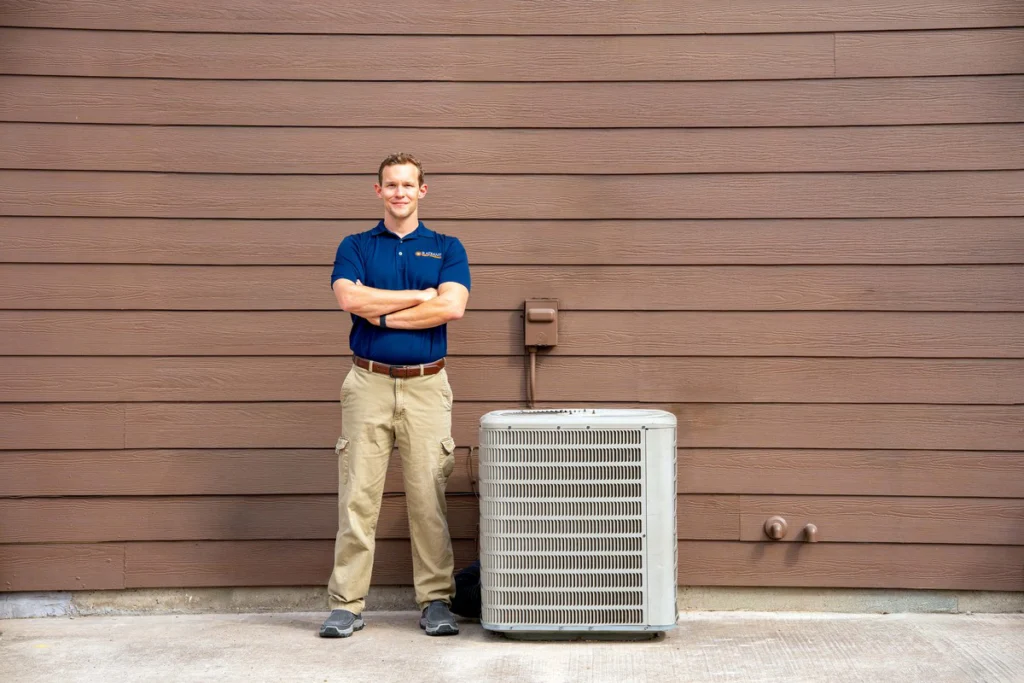
What to Watch For
Walk outside and look at the unit while the thermostat is calling for cooling. It tells you a lot.
Classic failed capacitor or a seized fan motor. Shut the system off; running it this way overheats the compressor.
The compressor is not running or not pumping. Could be a capacitor, a contactor, an overload trip or the compressor itself.
A compressor drawing locked-rotor amps, a shorted winding or a grounded fan motor. Stop resetting it and call.
Cedar pollen, cottonwood and grass clippings block airflow through the fins. Head pressure climbs and the compressor runs hot.
A compressor cutting out on its thermal overload. Often a dirty coil or a weak capacitor rather than a dying compressor, but it needs checking now.
Refrigerant carries oil. An oily spot on a line or the coil is a leak, and low charge is what kills compressors.
What We Repair
From the cheapest part in the unit to the most expensive, tested in that order.
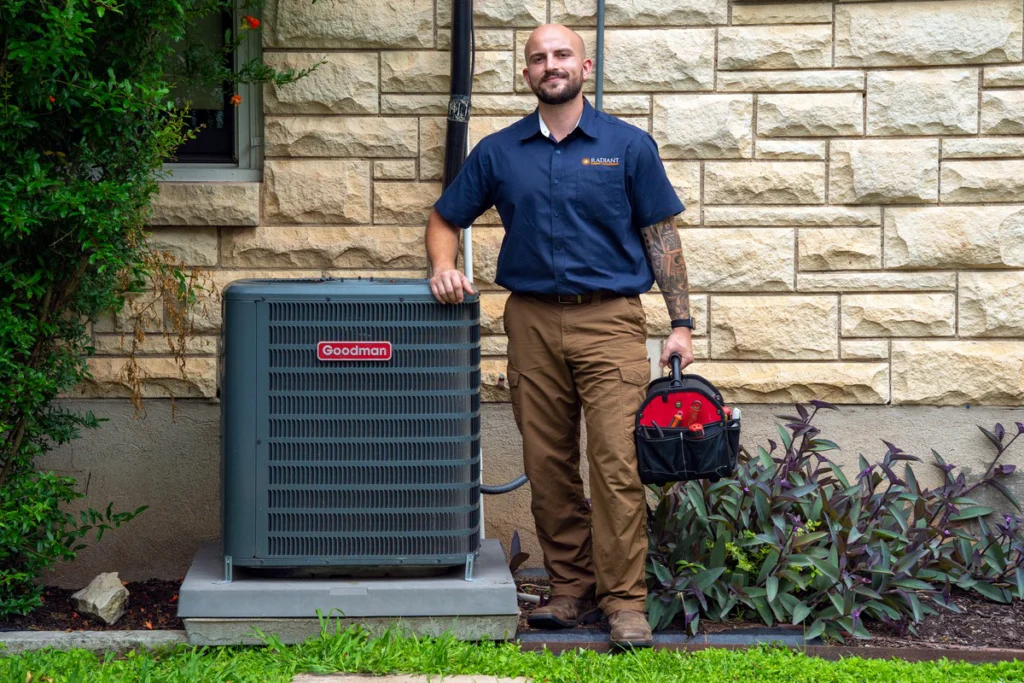
How It Works
Cheap parts first, expensive parts last, and nothing replaced on a hunch.
Is the fan turning, is the compressor running, is the coil blocked, is there oil on the lines. Half the diagnosis is in the first minute.
Capacitor value, contactor condition, fan and compressor amps, compressor windings, then refrigerant pressures if the electrical checks out.
What failed, what caused it and what it costs to fix. If it is the compressor on an old unit, the replacement number is on the same page.
Part replaced from the truck in most cases, then amps and pressures rechecked so we know the fix held and the cause is gone.
Save on the work your home needs most.
Turn the system off and call. A capacitor today is cheaper than a compressor next week.
Don't just take our word for it — hear from our satisfied customers
Maintenance Membership
Home maintenance for $9.99 a month.
Care Club members get two HVAC tune-ups and a plumbing safety inspection every year, priority scheduling, no dispatch fees — ever — and 5% off every repair.
The condenser is the whole outdoor unit: the metal cabinet with the fan on top and the coil around the sides. Its job is to release the heat that the system collected inside your house. The compressor is one component inside that cabinet, the pump that pushes refrigerant through the entire system. Homeowners often hear “you need a new condenser” and “you need a new compressor” as the same thing, but they are not. A compressor can be replaced inside an existing condenser, and many condenser problems, like a failed fan motor or capacitor, have nothing to do with the compressor at all. That distinction is why we test the individual parts before quoting.
A loud hum from the outdoor unit with the fan not turning almost always means a failed run capacitor: the motor is getting power but cannot start. A buzz can also be a contactor whose contacts are pitted or a compressor trying and failing to start. Either way, turn the system off at the thermostat. A compressor that keeps trying to start against a dead capacitor overheats and can fail for good. This is one of the fastest, least expensive repairs we do when it is caught early, and one of the most expensive when it is ignored through a heat wave.
Sometimes, but it is often a false economy. The outdoor condenser and indoor evaporator coil are designed as a matched pair, and a new outdoor unit on an old coil typically will not reach its rated efficiency. Many manufacturers also limit warranty coverage on mismatched systems. Refrigerant is the other issue: new equipment uses a newer generation of refrigerant than older systems, and an older coil may simply not be compatible. If the indoor coil is only a few years old and a match is available, replacing the condenser alone can make sense. We will tell you which case you are in and price both options.
Yes, gently, and it helps. Shut the power off at the disconnect by the unit, clear leaves, grass and anything growing within a couple of feet, and rinse the coil with a garden hose at low pressure, ideally from the inside out. Do not use a pressure washer; it folds the aluminum fins flat and does more harm than the dirt did. What a hose cannot do is remove the layer of cedar pollen and grime that bonds to the fins over a summer, which takes a coil cleaner, or straighten fins that are already bent. That is part of a tune-up, along with the electrical tests that a rinse does not cover.
