Cities We Serve
Austin Area:
San Antonio Area:
Not seeing your area? Give us a call at (833) 656-4056


Air Conditioning That Keeps Up With Texas
Repair, maintenance, condenser service and new installations for homes across Austin, San Antonio and the Hill Country. Licensed technicians, 24/7, with the price in writing before we start.
A central air conditioner in Austin or San Antonio can run twelve hours a day for months, pushing heat out of the house while the attic above the ductwork sits at 130 degrees or more. Every part of the system is working near its limit: the compressor cycles thousands of times a summer, the outdoor coil packs with cedar pollen and road dust, and the condensate drain pushes gallons of water a day through a line that grows algae in our humidity. Small problems do not stay small for long.
Our cooling work covers the whole system. AC repair when it has stopped or is not keeping up. Tune-ups that catch the weak capacitor before the heat wave does. Condenser and compressor work on the outdoor unit, where most Texas failures begin. And when the numbers say replace, a properly sized new system with a manager’s quality review on the install.
Looking for your local team? See air conditioning service in Austin or air conditioning service in San Antonio.
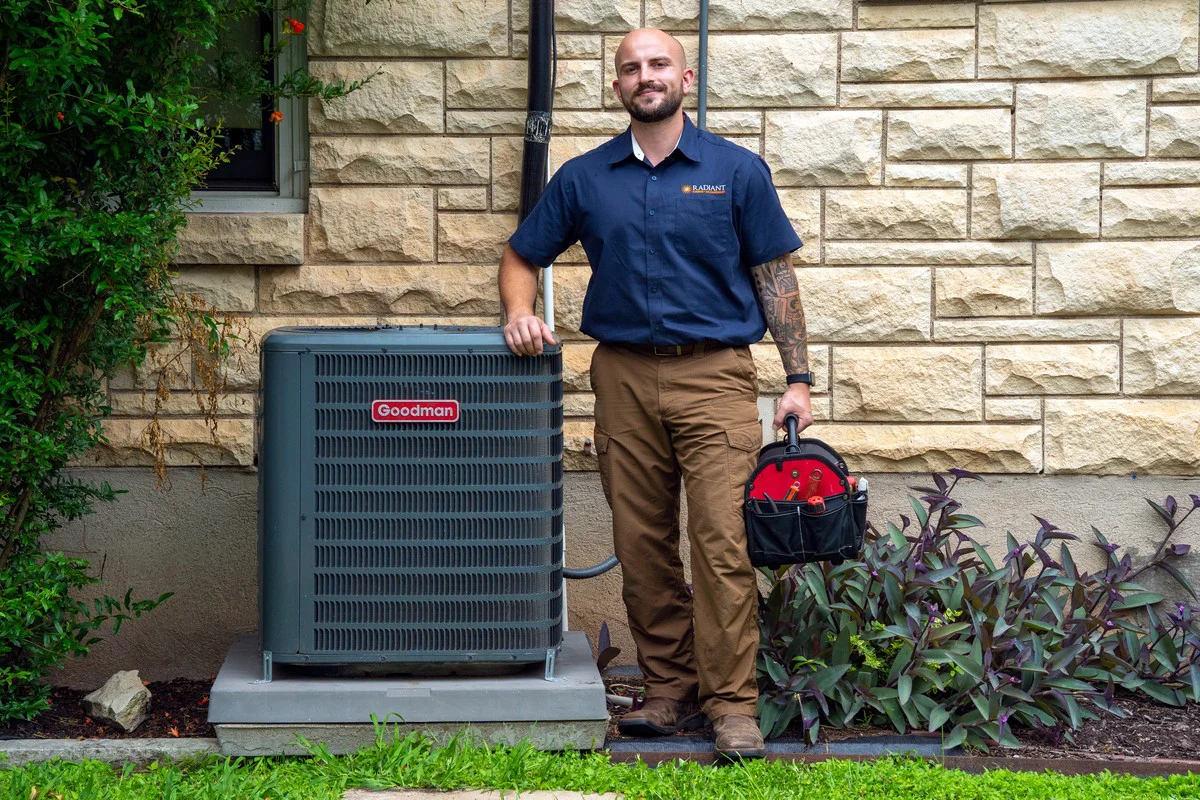
From a same-day capacitor swap to a full system with new ductwork.
Save on the work your home needs most.
Radiant runs from offices in Austin and San Antonio, so the technician who shows up knows the housing stock, the pollen and the water on your side of I-35. If you would rather start from your city, see our pages for Austin AC repair and San Antonio AC repair, or the full Austin and San Antonio cooling pages. Either way, it is the same licensed crew, the same upfront pricing and the same Home Comfort Guarantee.
Ten to fifteen years is a fair expectation for a central air conditioner in Austin or San Antonio, and the difference between the two ends of that range is mostly maintenance. A system that gets its coils cleaned, its refrigerant charge verified and its capacitor tested every spring tends to reach the far end. One that runs on a clogged filter with a coil full of cedar pollen works harder every hour and burns out its compressor early. Our summers simply put more run hours on a unit each year than most of the country sees, so a 12-year-old system here has done the work of a much older one elsewhere.
It is a calculation, not a sales pitch, and we will do it with you. The inputs are the age of the equipment, what you have already spent on it, the cost of this repair, and what the next likely failure is. A $300 capacitor on a seven-year-old system is an easy repair. A compressor on a 14-year-old unit that still uses an older refrigerant is usually money better put toward a new system, especially with financing available. Whatever we recommend, it goes in writing with the numbers next to it, and the quote is good for 72 hours so you are never deciding under pressure on a hot afternoon.
The right size comes from a load calculation on your actual house: square footage, ceiling heights, window area and orientation, insulation levels, duct condition and how many people live there. It does not come from copying the tonnage on the old unit, which may have been wrong to begin with. Oversized systems are a common problem in Central Texas. They cool the air fast, shut off before they pull the humidity out, and leave the house clammy while short-cycling the compressor to an early death. An undersized system runs all day and never catches up on a 105-degree afternoon. We size every new installation from the load, and we will show you the math.
On the hottest afternoons of the year, a healthy system may run nearly nonstop and only hold the house within 15 to 20 degrees of the outdoor temperature. That is the equipment doing what it was sized to do. If it is 95 outside and the house is creeping past 80, something is wrong. The common causes we find are a dirty outdoor coil, a low refrigerant charge from a slow leak, a frozen evaporator coil from restricted airflow, a weak compressor, or duct leaks dumping cold air into the attic. Each has a different fix and a different price, which is why we diagnose the system instead of guessing from the symptom.
Don't just take our word for it — hear from our satisfied customers



