


Cities We Serve
Austin Area:
San Antonio Area:
Not seeing your area? Give us a call at (833) 656-4056


Power Restoration
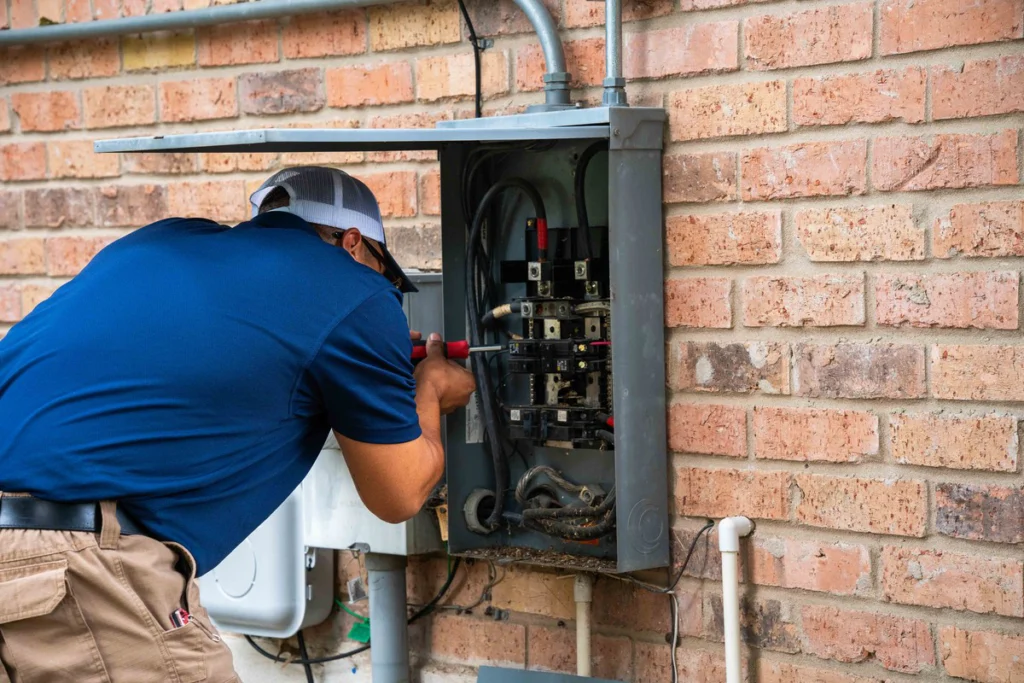
Central Texas has had enough grid trouble that the first assumption when the lights go out is that it is everyone. Look outside. If the street is lit and your house is dark, or if half your house works and the other half does not, the problem is on your side of the meter, and the utility is not coming to fix it. That is the call Radiant’s electricians take, at any hour, across Austin and the surrounding cities.
The causes are a short list and we work through it in order. A main breaker that tripped and will not reset. A failed breaker or a burned connection inside the panel. One leg of the 240-volt service lost at the panel, the meter base or the connection at the weatherhead. A service mast pulled loose by a storm or a fallen limb, which in most cases is the homeowner’s to repair, not the utility’s. Water in an outdoor panel or junction box after a heavy rain. Rodent damage in the attic. Occasionally, a whole-house problem that turns out to be a single failed GFCI feeding far more than it should.
We diagnose it with a meter, tell you what failed and what it takes to fix it, and give you a written price before the repair starts. When the fault is on the utility side, we tell you that too and help you make the call. If you lost power because a storm tore the mast off the house, we repair the service entrance and coordinate the reconnect. Every repair is backed by the Home Comfort Guarantee. For homes that cannot afford to go dark again, see standby generators; for a panel that keeps failing, see panel replacement.
Your House or the Grid?
If any of these fit, the utility is not the answer. We are.
The simplest test there is. Lights on next door and dark at yours means the fault is between the pole and your panel.
Some rooms work, some do not, and the dryer or AC will not run. A lost leg of the 240-volt service. Turn the big appliances off.
It trips again instantly, or the handle feels loose. A fault downstream or a failed main. Do not force it.
The classic sign of a loose or lost neutral. It can push unsafe voltage to electronics. Call the same day.
A storm or a limb pulled the service entrance. Stay well clear, call the utility about the drop, and call us about the mast.
A surge on restoration took out the router, the garage opener or the AC control board. Surge protection prevents the next one.
What We Do
Everything on the homeowner’s side of the meter, and honest advice about the rest.
How It Works
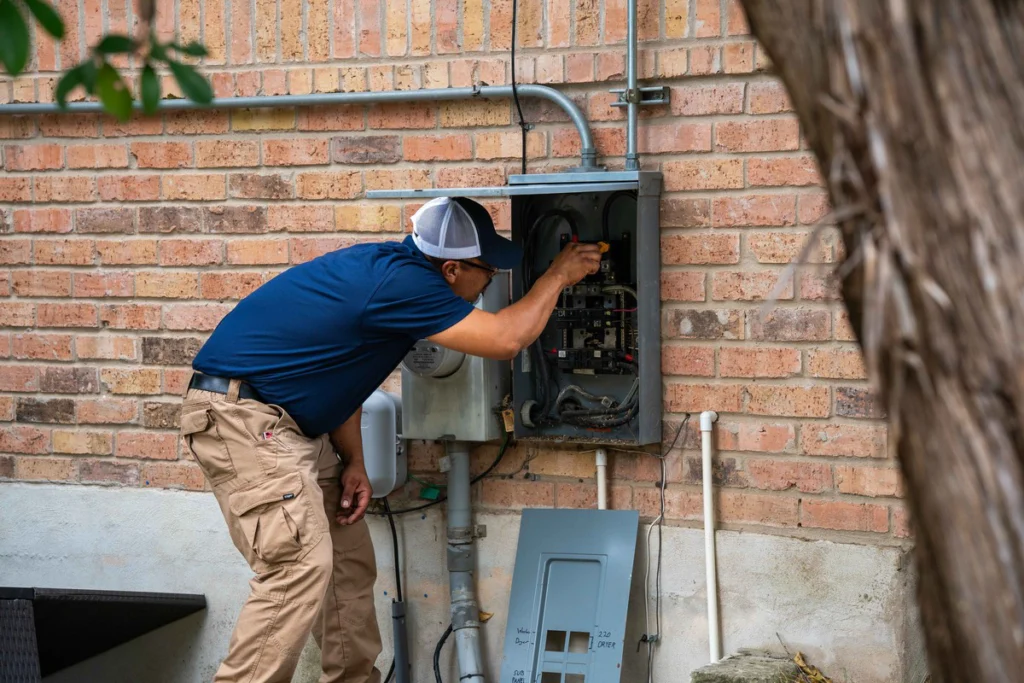
A short checklist on the phone, then a methodical search on site.
Are the neighbors out? Is it the whole house or part? Anything hot, buzzing or hanging? It tells us what to bring and what to tell you to switch off.
Voltage at the meter, at the main, at the bus and out to the circuits. The fault is wherever the readings stop making sense.
What failed, what it takes and what it costs. If it is the utility’s side, we say so and help you reach them.
Many faults can be repaired on the first visit. We bring the house up circuit by circuit and check for anything the outage damaged.
Save on the work your home needs most.
A licensed electrician is available now, with the price agreed before the repair starts.
Don't just take our word for it — hear from our satisfied customers
Maintenance Membership
Home maintenance for $9.99 a month.
Care Club members get two HVAC tune-ups and a plumbing safety inspection every year, priority scheduling, no dispatch fees — ever — and 5% off every repair.
Look at the neighbors first. If the whole street is dark, it is the utility, and your provider’s outage map or line is the right call. If your house is the only dark one, or only part of it is out, the fault is almost certainly on your side. Check the main breaker in the panel: if it is tripped, reset it once and see whether it holds. Check every GFCI reset button, because one can feed more than you expect. If the main trips again, will not reset, or the panel is warm or buzzing, stop there and call us. Do not open the meter base or touch anything on the mast; that is where the utility’s power comes in unfused.
Leave it off. A main that trips as soon as you reset it is protecting the house from a real fault, either a short on a branch circuit that its own breaker did not catch, or a problem inside the panel itself. Sometimes turning every branch breaker off, resetting the main, and then turning branches on one at a time will find the circuit at fault, and that is a reasonable thing to try if the panel is cool and quiet. If the main will not hold even with every branch off, or the handle feels loose and dead, the main breaker or the panel has failed and needs a licensed electrician. Unplug sensitive electronics while you wait.
Power restoration is rarely clean. When the grid re-energizes, voltage can spike briefly, and motors across the neighborhood all starting at once make it worse. Electronics take the hit first: routers, garage door opener boards, the control board in the air conditioner or furnace, the water heater’s electronics, and anything with a power supply. A whole-home surge protective device at the panel clamps those spikes before they reach your circuits and is the fix for next time. For what already failed, we can test circuits and devices to sort out what is dead and what just needs a reset. Some of the HVAC repairs after an outage are our heating and air team’s work, and we hand those off cleanly.
Usually both of you. The overhead drop from the pole to your house belongs to the utility, and they will reconnect it. The mast, the weatherhead, the attachment point on the house and the meter base are typically the homeowner’s responsibility, and the utility will not reconnect to a damaged mast. So the order is: stay well away from any downed or hanging wire, report it to your utility, and call us to repair the service entrance. We straighten or replace the mast, re-secure the attachment, check the meter base and the panel for damage, and coordinate the reconnect so it happens once, not twice.
Yes, and right after an outage is when most people ask. The device mounts at or beside the main panel and connects to a breaker, and it diverts voltage spikes to ground before they travel down your circuits. It protects the equipment you cannot plug into a power strip, which is most of the expensive equipment in a house. Installation is a short visit for a panel with an open slot or two. It pairs well with a panel evaluation, and if you are already considering a standby generator for the next long outage, both can be planned in the same quote.
