


Cities We Serve
Austin Area:
San Antonio Area:
Not seeing your area? Give us a call at (833) 656-4056


Ceiling Fan Installation
A ceiling fan does not lower the temperature of a room. It moves air across your skin, which makes the same room feel several degrees cooler. In a Central Texas summer that lets you push the thermostat up a few degrees without anyone noticing, and every degree you do not ask the air conditioner for shows up on the bill. Fans in the bedrooms and the living room are the lowest-cost comfort upgrade in Austin, and they run on a fraction of what the AC draws.
The catch is the mounting. A fan is a spinning weight hanging from your ceiling, and it needs a box rated for fans, screwed to a brace or a joist, not the thin plastic light box the builder used. Most wobbles, hums and “the fan is pulling away from the ceiling” calls we take trace back to the wrong box. The other common problem is the wiring: a single switch leg where you want the light and the fan controlled separately, or a smart control that needs a neutral the box does not have.
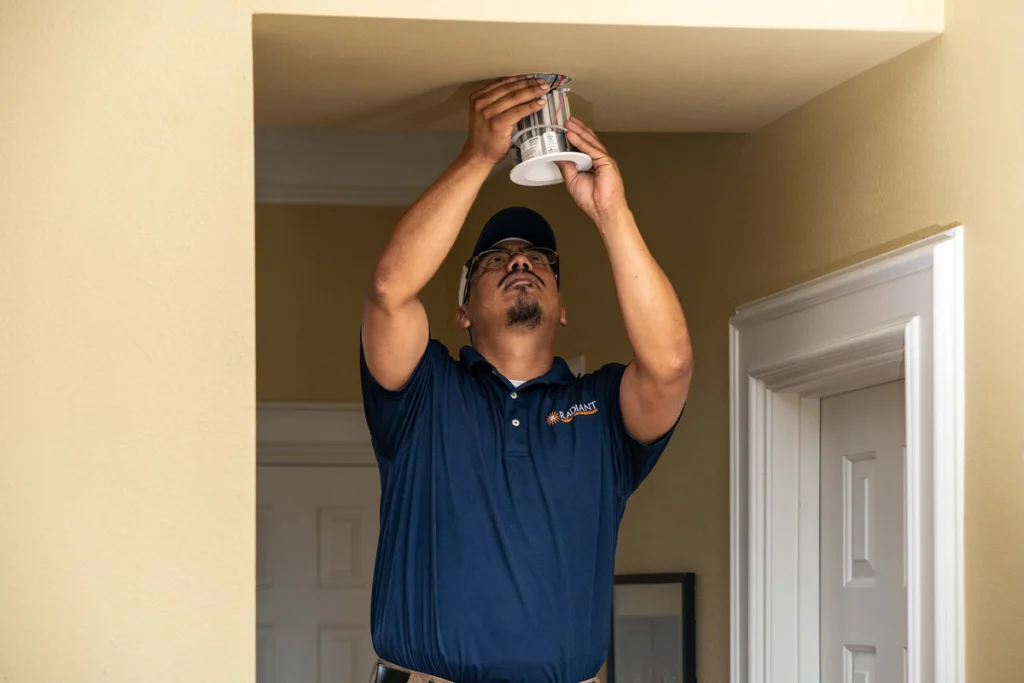
Radiant’s licensed electricians install and replace ceiling fans across Austin and the surrounding cities. We set the right box and bracing, choose the downrod length for the ceiling height, wire the fan and light on separate controls when you want them, balance the blades and test the remote. If there is no fixture in the room at all, we run a new switched circuit. Every fan is priced in writing before we start and backed by the Home Comfort Guarantee. For the rest of the room, see indoor lighting and switches and dimmers.
What We Hear
Some are annoyances. A fan that is loosening from the ceiling is not one of them.
Unbalanced blades are the harmless version. A box not rated for fans is the one that ends with the fan on the floor.
A hum can be a dimmer on a fan circuit. Clicking is often a loose blade. Grinding is a motor bearing and usually means replacement.
You want the light off and the fan on at night. We add a switch leg or a wall control that handles both.
A bedroom with only lamps, or a covered patio. We run a new switched circuit and set a proper box.
A fan hugging a high ceiling moves no air where you are. The right downrod and a sloped-ceiling mount fix it.
Newer DC-motor fans are quieter, use far less power and come with remotes. A like-for-like swap is a quick visit.
What We Do
Indoors, on the patio and in the rooms that never had a fixture.
How It Works
Short visit, careful mounting, no wobble when we leave.
Existing fixture or none, ceiling height, and whether you have already bought the fan. We book a window that works.
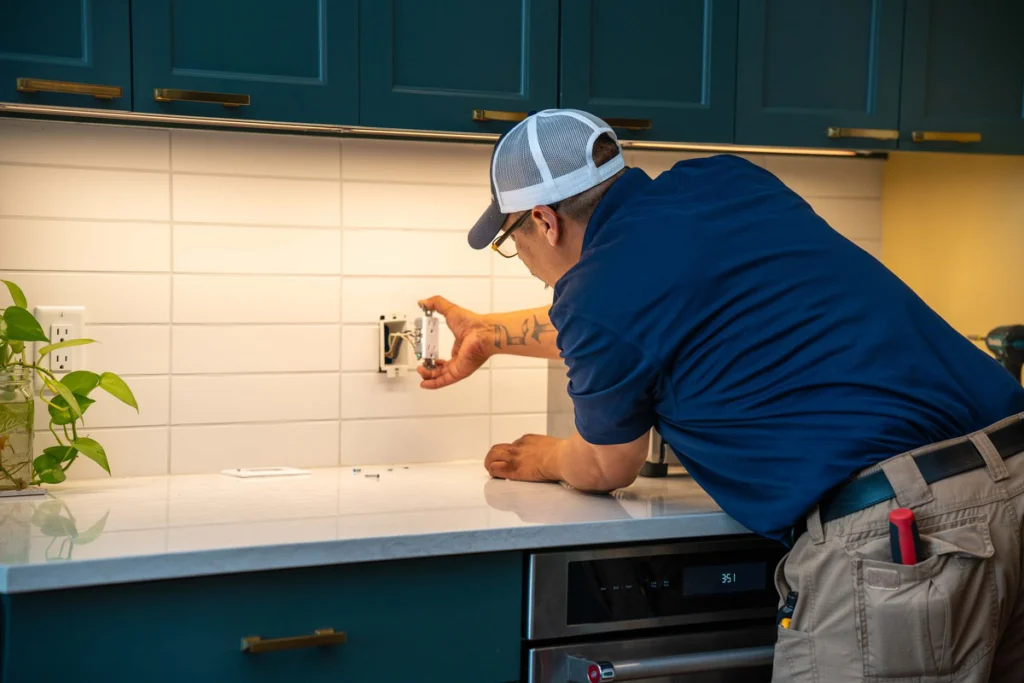
The electrician confirms the box is fan-rated and braced, and looks at the switch wiring for separate fan and light control.
Mounting, wiring, controls and any new circuit in one written number before a tool comes out.
Fan mounted, blades balanced, every speed and the light tested, remote paired, and the old fan hauled off.
Save on the work your home needs most.
A licensed electrician can hang several in one visit, priced in writing first.
Don't just take our word for it — hear from our satisfied customers
Maintenance Membership
Home maintenance for $9.99 a month.
Care Club members get two HVAC tune-ups and a plumbing safety inspection every year, priority scheduling, no dispatch fees — ever — and 5% off every repair.
Start with the blades. One blade slightly out of plane, a loose blade screw or a warped blade will make a fan wobble at speed, and a balancing kit or a tightened screw fixes it. If the whole fan body moves, the problem is above the canopy: a loose mounting bracket, a downrod pin that is not seated, or a ceiling box that was never rated to hold a fan. That last one matters. Standard light boxes can pull out of the drywall over time under a fan’s vibration. If the fan moves when you push gently on the housing with the power off, have it checked before you run it again.
Yes. It takes a new switched circuit, or a new switch leg from an existing lighting circuit with capacity to spare, run through the attic to a fan-rated box mounted on a brace between the joists. With attic access above the room, the ceiling cut is just the hole for the box and the switch location on the wall. Without attic access, over a first-floor ceiling with a floor above, we fish the cable inside the wall and ceiling where we can and talk through any patching honestly. Bedrooms in older Austin homes that were built with lamps only are the most common version of this job.
In summer the blades should turn counterclockwise when you look up at the fan, pushing air straight down so you feel a breeze. That is the setting that lets you raise the thermostat. In winter, flip the small switch on the motor housing, or use the remote, to run it clockwise on low. That pulls air up through the center and pushes the warm air that collects at the ceiling back down the walls without a draft. It is a small effect in our mild winters but noticeable in rooms with high ceilings. Remember that a fan cools people, not rooms, so turn it off when nobody is in there.
They can, but only if you use them to run the air conditioner less. A fan uses very little power, far less than the AC, and the breeze lets most people set the thermostat a few degrees higher and feel the same. Over a Central Texas cooling season that runs from April into October, a few degrees on the thermostat is a real reduction in AC run time. If you leave the thermostat where it was and just add fans, the bill goes up slightly, not down. Modern DC-motor fans use even less than older models, which is one reason a replacement can pay for itself over a few summers.
Yes, and it is worth doing right because a fan mounted tight to a 14-foot ceiling moves air up there and not where you are sitting. For a sloped ceiling we use a mounting bracket designed for the angle, and for height we choose a downrod that brings the blades to roughly eight or nine feet above the floor, which is where they do the most good. Tall-ceiling installations need a ladder or scaffold and sometimes two people, so they take a bit longer than a standard room, and the quote reflects that. Great rooms and two-story entries in newer Austin-area homes are the usual candidates.
