


Cities We Serve
Austin Area:
San Antonio Area:
Not seeing your area? Give us a call at (833) 656-4056


Electrical Repair
Most electrical problems announce themselves politely at first. A breaker trips once a month. A light flickers when the dryer starts. An outlet in the guest room stops working and nobody uses it anyway. The temptation is to reset it, ignore it, or plug the lamp in somewhere else. The trouble is that each of those symptoms has a cause, and the cause is usually heat at a connection somewhere you cannot see, which is how electrical fires start.
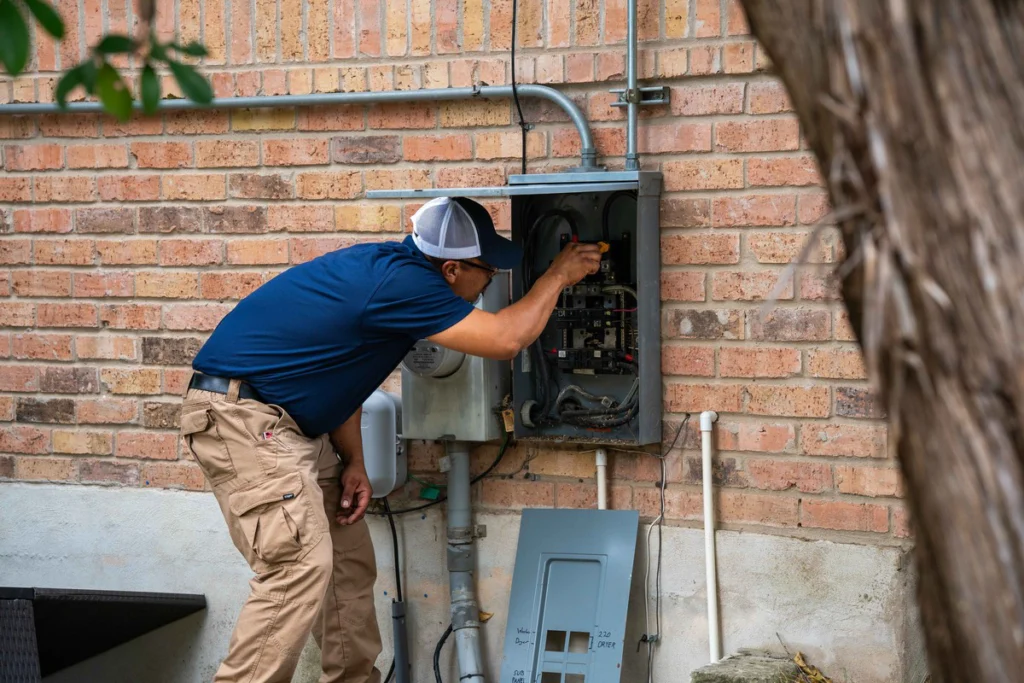
Radiant’s licensed electricians repair the whole range of it across Austin and the surrounding cities. We trace a tripping breaker to the overloaded circuit, the failing appliance or the short that is actually causing it. We find the loose backstab connection that killed half the outlets on a wall. We diagnose the flicker that is really a loose neutral at the panel or a corroded connection at the meter. We deal with the aluminum wiring in a 1970 home in Crestview or Georgetown that has been quietly loosening at every device for fifty years.
The electrician tests before naming the fault, explains it in plain terms, and gives you a written price you approve before the repair starts. If something is unsafe to keep using, you hear that plainly too. Repairs are backed by the Home Comfort Guarantee, and Care Club members get 5% off with no dispatch fee. If the problem is a house with no power at all, start at power restoration; if it is sparking, smoking or hot right now, go to emergency service.
What to Watch For
Anything hot, smelling or sparking means stop using it and call now. The rest should not wait long.
Overload, a short, a ground fault or a breaker that has worn out. Resetting it over and over is not a fix.
In one fixture, probably the fixture. Across the house, possibly a loose neutral or a service connection, which is serious.
A tripped GFCI, a loose connection upstream, or a device that has failed. We trace the circuit instead of guessing.
Heat at a device is a bad connection under load. Turn the circuit off and call. This is the one that starts fires.
Often one leg of the 240-volt service, at the panel or the utility connection. Dangerous for 240-volt appliances. Call today.
Arcing or a failing breaker. A faint hum from a dimmer is normal; a buzz from a panel is not.
What We Repair
One licensed electrician for everything between the meter and the light bulb.
How It Works
Diagnose, price, fix, verify. In that order, every time.
What is happening, where and when. If anything is hot or smoking, we tell you what to switch off while we are on the way.
The electrician takes readings and traces the circuit. A symptom points somewhere; the meter confirms it.
What failed, what the fix involves and what it costs. If a bigger repair is the honest answer, you hear that too.
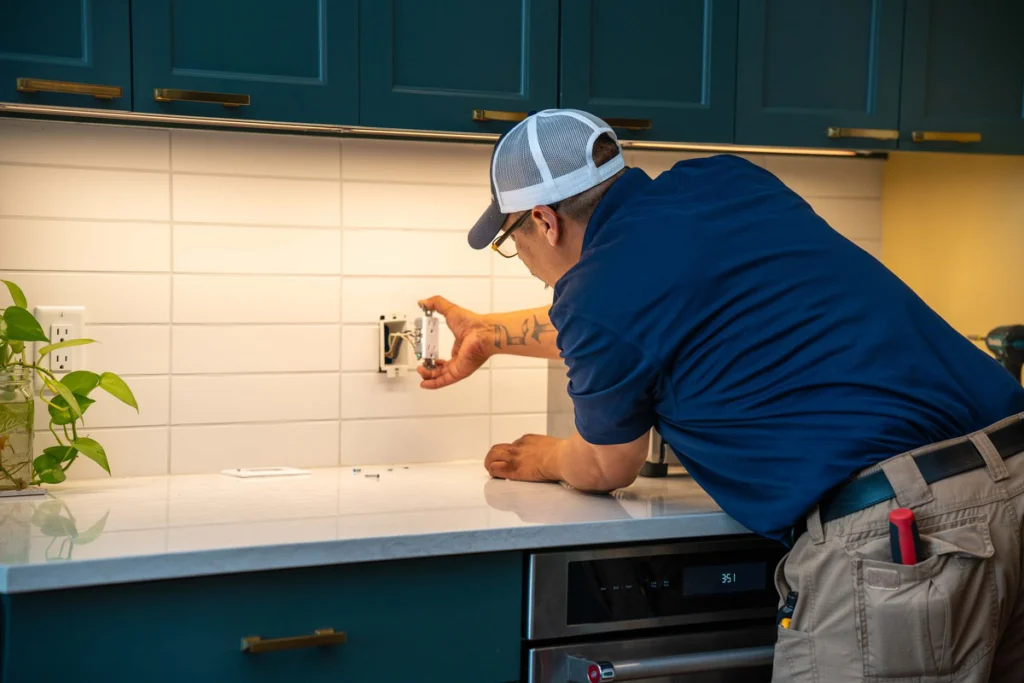
Repairs can often be finished on the first visit with parts from the truck. We test the circuit with a real load before we leave.
Save on the work your home needs most.
A licensed electrician will find the cause and price the fix before starting, any day of the week.
Don't just take our word for it — hear from our satisfied customers
Maintenance Membership
Home maintenance for $9.99 a month.
Care Club members get two HVAC tune-ups and a plumbing safety inspection every year, priority scheduling, no dispatch fees — ever — and 5% off every repair.
A breaker trips for one of four reasons: the circuit is carrying more than it is rated for, there is a short somewhere, there is a ground fault, or the breaker itself has worn out. Resetting it once to see if it holds is reasonable. Resetting it repeatedly is not, because each trip under a real fault is the breaker doing its job, and forcing it to stay on keeps current flowing through whatever is wrong. If it trips immediately with a snap, or trips with a smell, leave it off and call. If it trips only when a particular appliance runs, that appliance or its circuit is the place to look.
Residential service comes in as two 120-volt legs. When one leg is lost, roughly half the 120-volt circuits go dead and the 240-volt appliances, like the dryer, range and air conditioner, behave strangely or stop. The cause is at the main breaker, inside the panel, at the meter base, or at the utility’s connection on the pole or at the transformer. If your neighbors are fine, it is usually on your side. Turn off the 240-volt appliances to protect them, then call. A lost leg can also come with a lost neutral, which sends unsafe voltage to the circuits that still work, so this is one to get looked at the same day.
Yes, treat it as one. A dimmer can run slightly warm by design, and a plate near a heat source may pick up a little warmth. Anything beyond that means resistance at a connection: a loose wire on the device, a worn receptacle gripping a plug badly, or a backstab connection that has loosened. Resistance makes heat, heat makes more resistance, and the cycle ends in scorched insulation or a fire inside the wall. Unplug whatever is in the outlet, switch the breaker for that circuit off if you can identify it, and call. The repair itself is usually quick; the risk of leaving it is not worth the wait.
A compressor pulls a large surge of current for a moment when it starts, and that briefly drops the voltage across the house, which you see as a flicker. A quick, slight dim on a hot afternoon can be normal, especially on an older 100-amp service. A pronounced or lengthening dim is not. It can mean the compressor is straining and drawing more than it should, the panel or service connections are loose or corroded, or the service is undersized for the load. We check the connections and the amperage the unit is drawing. If the AC is the problem, our HVAC team handles that side.
In most cases, yes. Homes built from roughly the mid-1960s to the early 1970s often have aluminum branch-circuit wiring, and its problem is the connections: aluminum expands, contracts and oxidizes at terminals in a way copper does not, so devices loosen over time and overheat. The accepted repair joins a short copper pigtail to each aluminum conductor with a connector rated for the purpose, at every outlet, switch, fixture and splice, then lands the copper on the device. It is methodical work through the whole house, but far less disruptive than rewiring. A full rewire is the answer only when the wiring has other damage.
