


Cities We Serve
Austin Area:
San Antonio Area:
Not seeing your area? Give us a call at (833) 656-4056


Lighting Installation
The part of a lighting job you see takes ten minutes: the fixture goes up, the switch goes on, the room looks better. The part that decides whether it works for the next twenty years happens in the attic and behind the wall. Is the circuit already carrying too much? Is the box rated for the weight of that chandelier? Are the recessed cans rated to touch insulation, or are they going to cook in a 130-degree Austin attic? Is the dimmer compatible with the LEDs, or will everything flicker at low settings?
Radiant’s licensed electricians handle all of it. We add recessed lighting to rooms that only ever had one center fixture, run new switch legs so a kitchen can have task lighting and mood lighting on separate controls, retrofit old incandescent cans with sealed LED wafers that stop leaking conditioned air into the attic, and hang the heavy fixtures on boxes and bracing that can hold them.
Older homes in Hyde Park, Tarrytown and Crestview often need a little more: a circuit that is already full, a box with no ground, or wiring from an era that does not like modern dimmers. We tell you what we find, price the fix in writing, and let you decide. If the project also calls for new outlets or smart switches or a ceiling fan, we do that in the same visit. Everything is backed by the Home Comfort Guarantee.
Is This Your House?
Some of these are style problems. A few are electrical problems wearing a style problem’s clothes.
The 1960s layout. Recessed lights on a dimmer transform a living room, and we can usually feed them from the existing switch.
An old incandescent dimmer driving LED loads. Swapping to a compatible dimmer fixes it. Occasionally a shared neutral is the real cause.
Non-IC cans with halogen bulbs, insulation pulled back around them, and a hole into the attic on every one. LED retrofits seal and cool them.
Shadows on the counter from a single ceiling light. Under-cabinet LED strips and pendants over the island, on their own switches.
Ordinary ceiling boxes are not rated for heavy fixtures. We add the bracing and a proper box before something lets go.
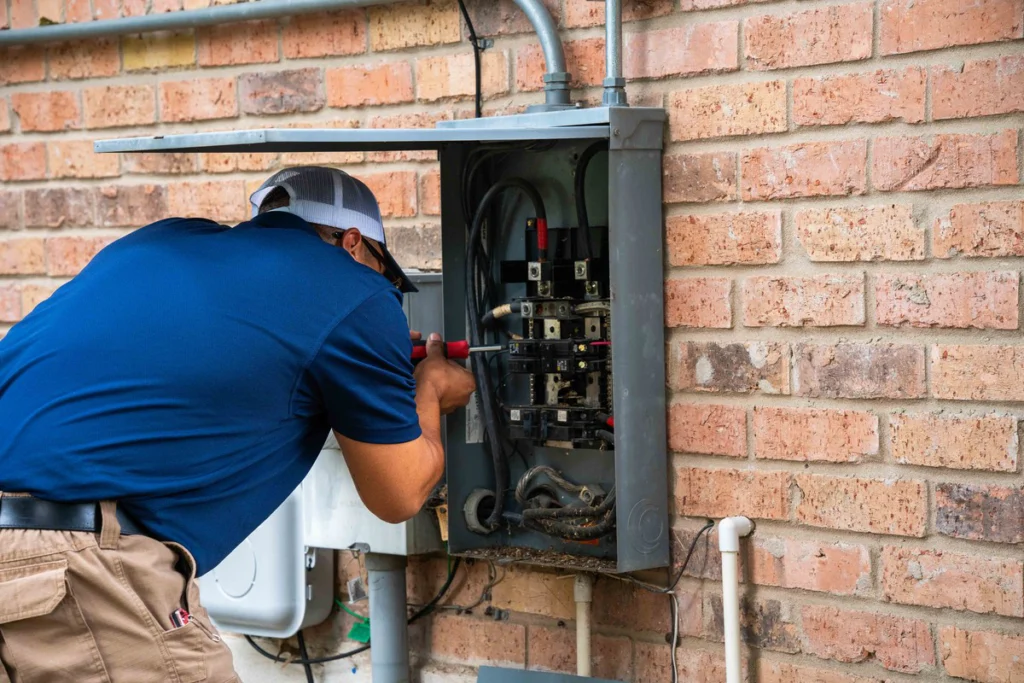
That is not a lighting problem. It can be a loose neutral or a panel issue and belongs on our repairs page. Call it in.
What We Install
Fixtures, controls and the wiring behind them, for one room or the whole house.

How It Works
You describe the room you want. We handle the wiring, the boxes and the code.
Tell us what bothers you and what you want. The electrician looks at the ceiling, the attic access and the panel while you talk.
Fixture spacing, dimmer zones, switch locations and which circuit feeds what. If the circuit is full, you hear that now.
Fixtures, wiring, controls and any drywall work in one number, honored for 72 hours.
We wire it, mount it, test every dimmer through its range, and clean up. Then you get to turn it on.
Save on the work your home needs most.
A licensed electrician will plan it with you and price it before any work begins.
Don't just take our word for it — hear from our satisfied customers
Maintenance Membership
Home maintenance for $9.99 a month.
Care Club members get two HVAC tune-ups and a plumbing safety inspection every year, priority scheduling, no dispatch fees — ever — and 5% off every repair.
Yes, and it is one of the most common lighting jobs we do in Austin’s older neighborhoods. The existing fixture gives us a switched circuit to start from. If that circuit has room for the added load, which is usually the case with LEDs, we run new cable through the attic to each can location and control the set from the same switch, often upgraded to a dimmer. With attic access above the room, the drywall cuts are just the holes for the cans. Without attic access, or over a second-floor ceiling with a floor above it, we talk through the options and price the extra work honestly.
Most of the time the dimmer was designed for incandescent bulbs. It controls light by chopping the power waveform, and an LED driver reacts to that with flicker, buzzing or a narrow range where the light jumps from off to bright. The fix is a dimmer rated for LED loads and, ideally, matched to the fixtures you have. Sometimes a mix of bulb brands on one circuit causes it. Less often, flicker that shows up across several rooms at once points to a loose neutral or a panel connection, which is an electrical fault rather than a compatibility problem. We can tell the difference quickly.
IC stands for insulation contact. An IC-rated can or wafer is built to run cool enough that attic insulation can touch it. A non-IC fixture needs a clearance gap, which in practice means someone pulled the insulation back and left a warm, unsealed hole into the attic above every light. In a Central Texas summer that attic can pass 130 degrees, so every one of those holes is pulling hot air into the room and conditioned air out. We install IC-rated, airtight fixtures and, when retrofitting old cans, use sealed LED trims that close the gap.
Color temperature is measured in Kelvin. Lower numbers around 2700K look warm and yellowish, like an incandescent bulb, and suit bedrooms and living rooms. Around 3000K is a soft white that works almost anywhere. 3500K to 4000K reads cleaner and brighter and is popular for kitchens, bathrooms and workspaces. Above that starts to feel like an office. The mistake we see most is mixing temperatures in one room, which makes the warmer lights look dingy. Pick one per room, or choose fixtures with selectable temperature so you can change your mind later.
