


Cities We Serve
Nearby Cities:
Not seeing your area? Give us a call at (512) 265-6994


Austin Emergency Plumbers
Austin does not have many plumbing emergencies in April. It has them in August, when a water heater that has been cooking in a 130-degree attic finally splits its tank over the bedroom ceiling, and in the handful of nights each winter when a blue norther drops the temperature into the teens and every uninsulated attic line and exposed hose bib in Pflugerville, Leander and Buda is at risk. February 2021 was the extreme case, but a two-night hard freeze does the same damage on a smaller scale most winters.
The rest of the year, the emergencies are the slow ones that finally announce themselves: a slab leak in a Round Rock house that has been running under the foundation for a month, or an old cast iron sewer line in Crestview that backs up into the tub the night you have guests. We have answered those calls since 1999, from the same Reinli Street office, and the price after midnight is the price at noon. For a full picture of what counts as an emergency and how we handle it, read our emergency plumbers page.
Call Now, Not Monday
If you are unsure, call anyway. We would rather talk you through a false alarm than see the damage from a real one.
In an Austin suburb that is usually the attic water heater or a split attic line. Kill the main, then the breaker or gas to the heater.
The burst happens during the freeze; the flood happens when it warms up. Shut the water off before the thaw, not after.
The main line is blocked, often by roots in an older central Austin sewer. Stop running water anywhere in the house.
Leave the house, do not flip switches, and call the gas utility first. Then call us for the repair and pressure test.
A broken yard line between the meter and the house, or a failed pressure-reducing valve. Check the meter for movement with everything off.
A hot-side slab leak. It is not a flood yet, but it is running the water heater nonstop and saturating the soil under your foundation.
What We Handle After Hours
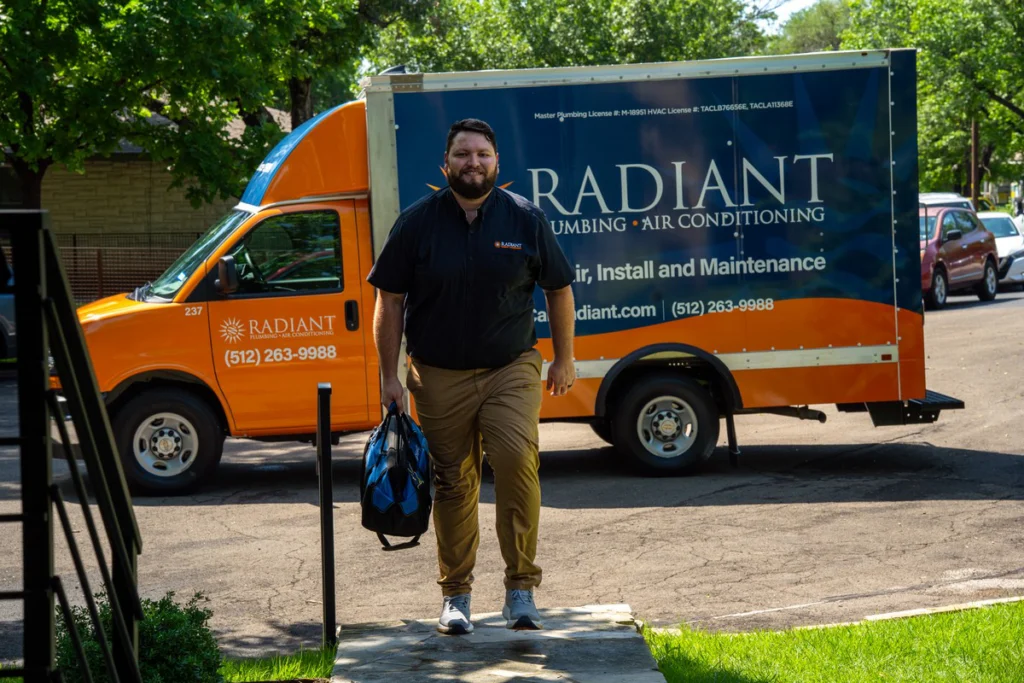
The truck carries what these calls need: shutoffs, supply line, water heater connectors, cabling and jetting equipment.

While You Wait
Three minutes of the right steps can save a floor. Then we handle the rest.
The main valve is usually near the front hose bib or in a box at the street. If it will not turn, tell us when you call. For a water heater, close the cold valve on top of the tank too.
Flip the breaker for an electric water heater or anything under a ceiling leak. Turn a gas heater’s control to off. Do not stand in water to do either.
Where the water is, what you have shut off, and your address from Georgetown to Buda. We book the soonest window and tell you what to expect.
We stop the water first, then give you a written quote for the permanent repair. Nothing beyond that happens until you say so.
Save on the work your home needs most.
Licensed plumbers on call 24/7 across the Austin area. No after-hours surprise fees, ever.
Don't just take our word for it — hear from our satisfied customers
Maintenance Membership
Home maintenance for $9.99 a month.
Care Club members get two HVAC tune-ups and a plumbing safety inspection every year, priority scheduling, no dispatch fees — ever — and 5% off every repair.
In most Austin-area homes built since the 1980s, there is a valve on the supply line where it enters the house, often near the front hose bib, in the garage, or in a plastic box in the front yard near the meter. Older central Austin homes may only have the valve at the meter box by the curb, which takes a meter key or a pair of pliers to turn. Find it on a calm day, turn it once to make sure it moves, and show the rest of the household. If it is seized or crumbling, we can replace it with a quarter-turn ball valve so it works when it matters.
Open the faucets slightly so pressure can escape, and shut the main off if you can reach it, because the pipe does not usually flood while it is frozen; it floods when it thaws. Do not use a torch or open flame on a pipe. Warm the room and the attic access if you can, and check the exposed lines in the garage and at the hose bibs first, since those freeze before anything inside the walls. In Austin, the lines that split are almost always in attics and exterior walls that were never insulated for a hard freeze. Once things thaw, walk the house and look for wet drywall; a slow leak from a hairline split can run for days. Our frozen pipe repair page has more.
It depends on the leak. A hot-side slab leak that has turned a section of tile warm is running your water heater around the clock and pumping water into the clay under your foundation, and that soil movement is what damages slabs in Round Rock, Pflugerville and Kyle. That is worth a call today, not next week. A small cold-side leak that only shows as a higher bill is urgent but not a middle-of-the-night call. Either way, we can locate it without tearing up floors at random, isolate it so the water stops, and give you the repair options in writing before anything is opened. Our leak detection service explains how the location work is done.
Yes. Care Club members get 24/7 emergency service at standard rates with no after-hours trip fee, no dispatch fees at any time, priority scheduling, and 5% off the repair itself. The membership is $9.99 a month and also includes an annual plumbing safety inspection, which is where we catch the attic water heater that is about to fail and the hose bib that is about to freeze before either becomes an emergency call. Full details are on the Care Club page.
