
Is Austin water hard? Yes, moderately. The city draws its supply from the Colorado River by way of the Highland Lakes, and that water spends its life running over and through Hill Country limestone, picking up dissolved calcium and magnesium along the way. Austin Water takes out part of that load at its treatment plants, but not all of it. What is left arrives at your tap, and every time water is heated or evaporates, it comes back out as the white crust you already know.
Why Austin Hard Water Starts with Limestone
Central Texas sits on the eastern edge of the Edwards Plateau, a thick bed of limestone laid down when this was sea floor. Rain falling on the Hill Country soaks through that rock, dissolves a little of it, and carries it into the creeks and rivers that feed Lake Buchanan, Lake Travis and Lake Austin. By the time the Colorado River reaches the city’s treatment plants it is carrying a steady load of calcium and magnesium, the two minerals that define hardness.
Austin Water has used lime softening at its treatment plants for about a century. Lime makes some of the calcium drop out of the water before it is pumped to the city, and the softened water is also less corrosive to pipes. The goal is partial softening, not soft water, so the utility rates what reaches homes as moderately hard. That is enough to scale a water heater and spot every glass in the cabinet. For the current figures, check Austin Water’s annual water quality report rather than relying on a number from a blog post; the readings move with lake levels and seasons.
The picture changes a little outside the city limits. Round Rock, Georgetown and several Williamson County systems blend lake water with Edwards Aquifer wells, which tends to run harder still. Homes on private wells in Dripping Springs, Spicewood and the western Hill Country usually have the hardest water of all, sometimes with iron or sulfur alongside it.
How to Tell If Your Austin Water Is Hard
You probably already have the evidence. Hard water announces itself in the same handful of ways in nearly every Austin home:
- White or gray crust on faucet spouts, shower heads and the rim of the toilet bowl
- Cloudy spots on glassware straight out of the dishwasher
- Soap scum on shower doors and tubs that comes back days after cleaning
- Soap and shampoo that will not lather well, and skin that feels dry afterward
- Towels and whites that come out stiff or dull
- A water heater that rumbles or pops as it heats
- A tankless water heater that throws error codes or runs lukewarm
If you want a real reading, inexpensive test strips from a hardware store give a rough grains-per-gallon figure in a minute, and a plumber can run a more precise test during a visit.
What Hard Water Does Inside Your House
Tank water heaters
Heat drives the minerals out of the water, and in a tank heater they settle as a layer of sediment on the bottom. On a gas heater that layer sits between the burner and the water, so the burner runs longer to heat the same tank, and the trapped water under the sediment boils and pops, which is the rumbling you hear. On an electric heater the scale coats the lower element until it burns out. Sediment also eats the sacrificial anode rod faster and shortens the tank’s life. An annual flush slows all of this down, but it does not stop it.
Tankless water heaters
Tankless units are more sensitive, not less. All the heating happens inside a compact heat exchanger with narrow passages, and scale builds there first. The unit senses the restriction, the flow sensor and temperature sensors drift, and you get error codes, reduced flow or water that will not hold temperature. Manufacturers call for periodic descaling with a pump and a mild acid solution, and in Austin that is a yearly job rather than an occasional one.
Fixtures and appliances
The scale you see on the outside of a faucet is also forming on the inside. Cartridges stiffen and drip, aerators clog, shower heads lose pattern, and toilet fill valves stick. Dishwashers and washing machines heat water too, so their heating elements, spray arms and inlet screens scale up and the appliance quietly loses performance years before it fails.
Your Options: Softener, Conditioner or Filter
Three categories of equipment get sold as hard water solutions, and they do different things. Picking the right one depends on what is bothering you.
Water softener
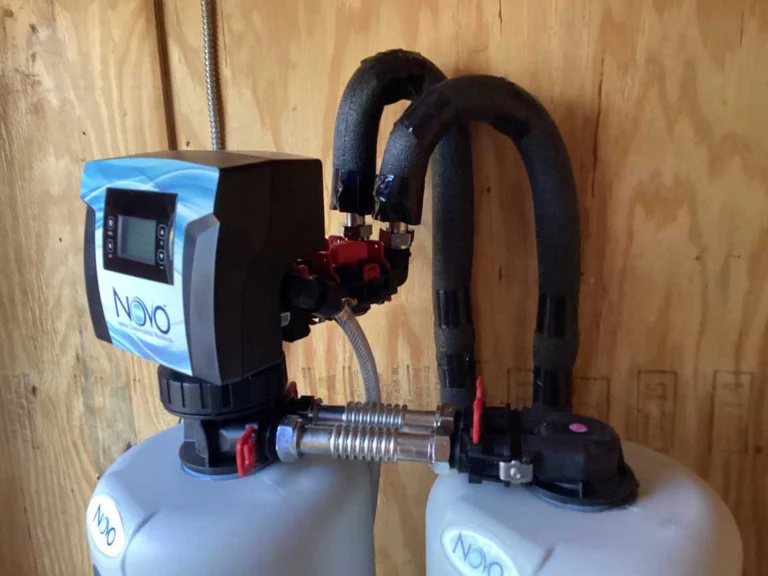
A true softener uses ion exchange. Water passes through a tank of resin beads that trade the calcium and magnesium for sodium or potassium, and the resin is periodically rinsed with brine from a salt tank to recharge it. The minerals are actually removed, so scale stops forming, soap lathers, glass dries clear and water heaters stay clean. The trade-offs are a salt tank to keep filled, a drain for the regeneration cycle, and a slightly slick feel to the water that some people need a week to get used to. In slab-built Austin homes the softener typically lives in the garage on a loop the builder may have already stubbed in.
Salt-free conditioner
A conditioner does not remove minerals. It changes how they behave, converting dissolved calcium into tiny crystals that are less inclined to stick to pipe walls and heating elements. Scale buildup is reduced, there is no salt and no drain, and the water tastes the same. What you do not get is soft water: soap still fights the minerals, glasses still spot, and the crust still forms where water evaporates. For a household that wants to protect a tankless heater without the feel of softened water, a conditioner can be a fair compromise. For a household tired of cleaning the shower door, it will disappoint.
Whole-house filtration
Carbon and sediment filters address taste, odor, chlorine or chloramine and particles. They make water more pleasant to drink and protect the equipment downstream. They do not soften water or reduce hardness in any meaningful way. Filtration is often paired with a softener rather than chosen instead of one, and an under-sink reverse osmosis unit is the common add-on for drinking water. Our Austin water quality page walks through what each stage removes.
Which One Fits Your Home
- Scale on everything and dull laundry: a softener, because only removal fixes those
- Protecting a tankless or new water heater, minerals otherwise tolerable: softener first, conditioner as the no-salt alternative
- Taste, smell or chlorine complaints: filtration, often alongside a softener
- Private well with iron or sulfur: test first; the treatment train depends on what is in the water
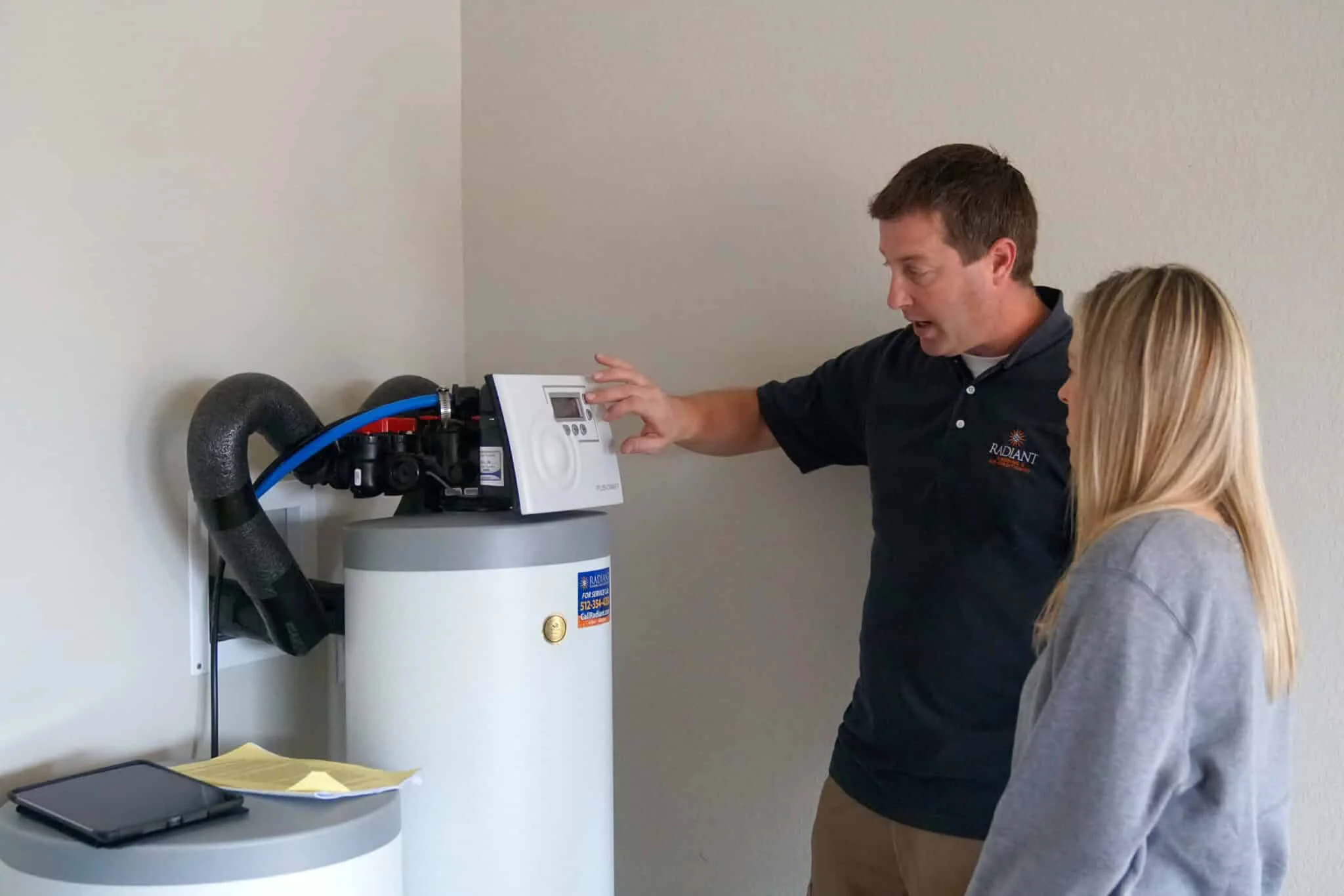
The honest starting point is a hardness test at your tap and a look at where equipment could go. Radiant has installed and serviced water treatment in Austin homes since 1999, and our licensed plumbers size the system to your household and your plumbing rather than to a catalog page. You approve upfront pricing before any work starts, there are no surprise fees, and the installation is backed by our Home Comfort Guarantee. See how we approach water softeners in Austin, or schedule a visit and we will bring the test kit.